
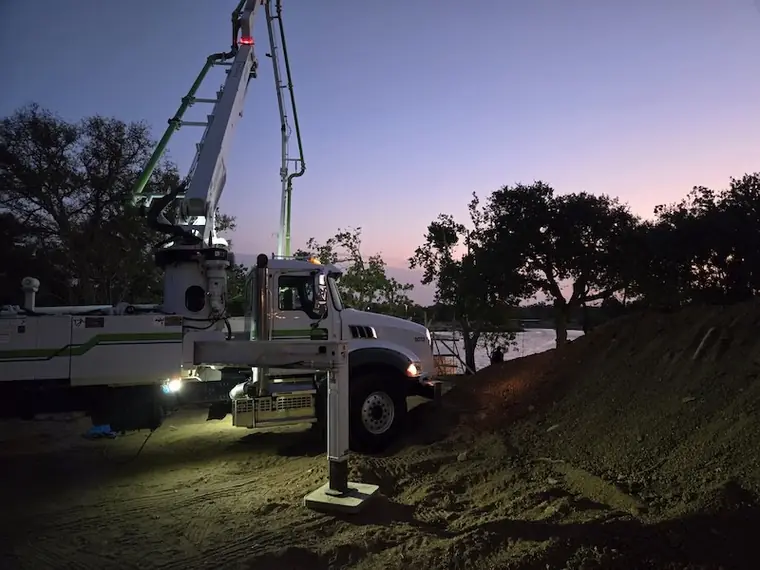
Pouring concrete in cold weather in Austin is less about the month and more about the next 48 hours of forecast. Most Austin winter days are mild enough to pour, but a single overnight freeze in the first two days after a pour can do lasting damage to a slab or driveway, so the plan for a winter pour is built around the coldest night on the forecast, not the afternoon high.
This guide covers what the industry counts as cold weather, how often Austin actually gets there, what changes before and after the truck arrives, and which decisions belong to the engineer rather than the crew.
What counts as cold weather for concrete?
The American Concrete Institute defines cold weather for concrete as a period when the average daily temperature stays below 40°F for more than three days in a row. Central Austin rarely strings together three days like that.
The second half of the ACI definition is the one that matters here. ACI says cold weather also exists whenever the air temperature falls, or is expected to fall, below 40°F during the protection period, which is the time fresh concrete needs before cold can no longer harm it. A warm Tuesday pour followed by a Wednesday-night cold front is a cold weather pour under that definition, even if the rest of the week is in the sixties.
How often does Austin freeze?
Austin averaged 12 freezes per winter between 1991 and 2020 at Camp Mabry, the city's official weather station, according to a KXAN analysis of the station's records. The same records put the average first freeze on Dec. 1 and the average last freeze on Feb. 15.
January carries about 38% of Austin's recorded freezes, December about 26% and February about 22%, per KXAN. Every calendar day between Oct. 30 and March 29 has seen at least one freeze at Camp Mabry, so a late-October or late-March pour is not automatically safe.
Why the first two days after a pour matter most
Fresh concrete is most vulnerable to cold before it has gained its early strength. The National Ready Mixed Concrete Association (NRMCA) says plastic concrete will freeze if its temperature drops below about 25°F, and that concrete which freezes in that state can lose more than 50% of its potential strength along with long-term durability.
NRMCA guidance is to protect new concrete from freezing until it reaches a minimum early strength, which takes about two days for most concrete held at 50°F. That two-day window is why the overnight low on the night of the pour, and the night after, drives every other decision on a winter job.
Cold also slows everything down. NRMCA's rule of thumb is that a 20°F drop in concrete temperature roughly doubles setting time, which pushes back finishing on a driveway and saw-cutting of control joints, and stretches a pour day well past what the same crew would need in May.
What changes before the truck arrives
Concrete placed on frozen or frosted ground sits on a base that will move as it thaws. NRMCA guidance is that snow, ice and frost are removed and that the subgrade, forms and any steel the concrete touches are above freezing before placement starts.
The concrete's own temperature is handled at the plant. NRMCA notes that the ready-mix producer controls concrete temperature by heating the mixing water or aggregates, and its guidance calls for thinner sections, under 12 inches, to arrive warmer, at about 55°F, than massive footings. Accelerating admixtures speed up setting, but NRMCA is clear that they do not stop concrete from freezing and do not replace protection.
- The forecast low for the pour night and the night after, checked again the afternoon before
- Frost and standing water cleared from the base, with forms and steel above freezing
- Any winter mix adjustments agreed with the supplier and the engineer ahead of time
- Blankets, plastic and curing compound on site before the first truck, not ordered after it
What changes after the pour
New concrete makes its own heat as it cures, and winter protection is about keeping that heat in. NRMCA lists insulated blankets, tarps and straw covered with plastic as common measures, and flags corners and edges as the places that lose heat fastest.
Water curing is not recommended when a freeze is coming, according to NRMCA, so winter slabs are cured with membrane-forming curing compounds or plastic sheeting instead. Coming off is as important as going on: NRMCA warns that cracking can follow when the surface and the interior of the concrete differ by more than about 35°F, so blankets come off gradually rather than all at once on a cold morning.
The test cylinders need the same care as the slab. NRMCA calls for acceptance cylinders to cure between 60°F and 80°F for the first 24 to 48 hours, in an insulated box with a thermometer, so the lab results reflect the concrete rather than a cold night in the back of a truck.
Who decides on a cold weather pour?
The engineer of record decides the mix requirements and the strength a foundation has to reach before the next step. On a post-tension foundation, DB Concrete stresses the cables only once the concrete reaches the strength the engineer specifies, and that point simply arrives later in cold weather.
The pre-pour inspection still has to pass before the concrete order goes in, whatever the forecast says. What DB Concrete decides on a winter job is the practical side: whether the forecast window is wide enough to pour, how the slab or driveway and flatwork will be protected, and when it is safe to uncover it. Pushing a pour a day to miss a hard freeze costs less than replacing concrete that froze in its first night.
If a foundation or driveway is planned for this winter, talk to DB Concrete about the schedule early, so the cold-weather plan is part of the proposal rather than a surprise on pour week.
Published Oct 27, 2026