
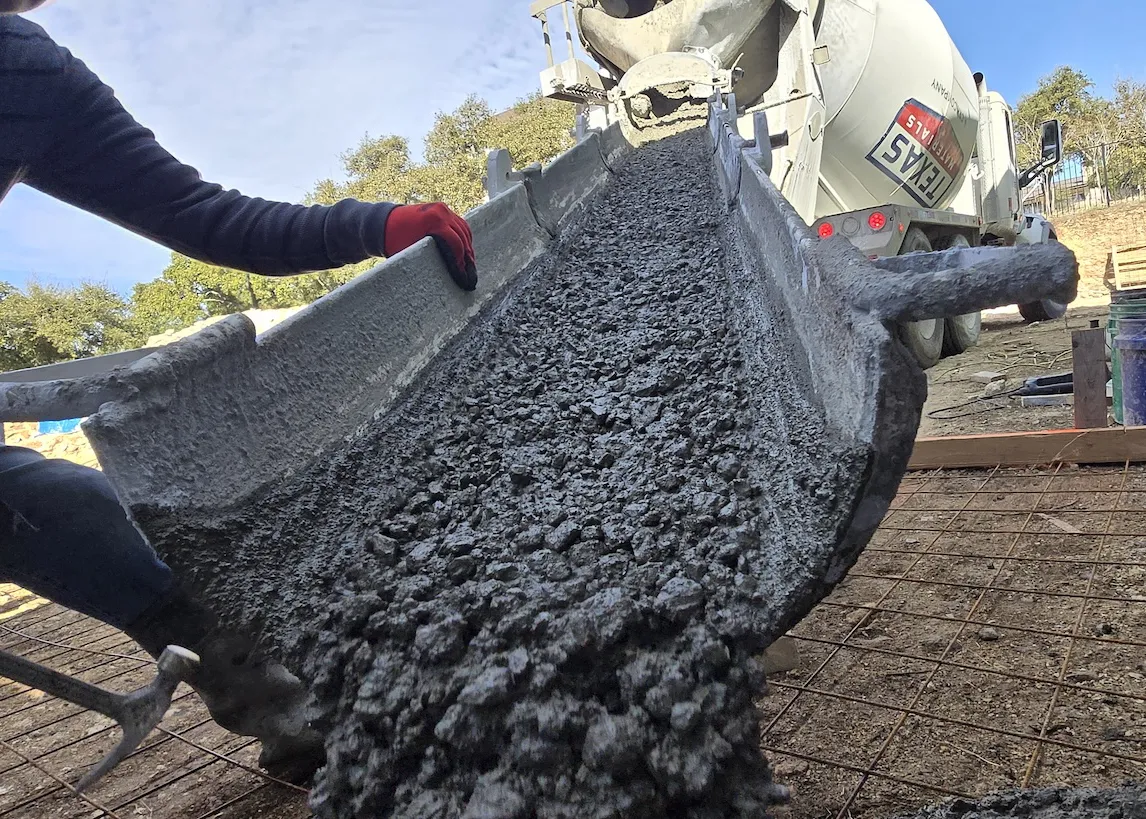
A slab foundation in Austin is not waterproofed. What goes under it is a vapor retarder: a plastic sheet laid over the prepared ground before the concrete is placed, which the 2024 International Residential Code requires under the slab floors of a house. The City of Austin enforces that code edition through Ordinance No. 20250410-040, which took effect on July 10, 2025.
What does Austin's code require under a slab floor?
Section R506.3.3 of the 2024 International Residential Code requires a minimum 6 mil polyethylene or approved vapor retarder between the concrete floor slab and the base course, or the prepared subgrade where there is no base course. The same section requires the joints in the sheet to be lapped not less than 6 inches. The full text is in the International Code Council's 2024 IRC, Chapter 5.
Austin's residential code ordinance deletes a list of sections from the 2024 IRC, and Section R506 on concrete floors on ground is not on that list. In Austin, the slab rules apply as the model code writes them.
The code minimum is a floor, not a design. A foundation's drawings and specification can call for a heavier or more specific product, and on a high-end custom home they usually name one.
Is a vapor retarder the same as waterproofing a slab?
A vapor retarder is not waterproofing. The sheet slows water vapor rising out of the ground into the underside of the slab; it does not make concrete waterproof, and it does nothing about water running toward the house across the surface of the lot.
The product standard says what the sheet is for in its title. ASTM E1745, reapproved in 2023, is the Standard Specification for Plastic Water Vapor Retarders Used in Contact with Soil or Granular Fill under Concrete Slabs.
Surface water is a grading and drainage question, and on Austin clay it is a structural one. Central Texas clay is stable when its moisture content is stable and moves when that moisture swings, which is why DB Concrete treats where a site sheds water as part of concrete sitework, settled before the foundation rather than after it.
Where can a vapor retarder be left out in Austin?
The 2024 IRC lists four exceptions to the vapor retarder requirement in Section R506.3.3:
- Garages, utility buildings and other unheated accessory structures.
- Unheated storage rooms with an area of less than 70 square feet, and carports.
- Driveways, walks, patios and other flatwork not likely to be enclosed and heated at a later date.
- Any slab where the building official approves leaving it out based on local site conditions.
The third exception deserves a second read on a custom home. A patio or a garage slab that may one day become a heated room is exactly the slab the exception does not cover, and there is no putting a sheet under a slab once the concrete is on top of it. If a future conversion is even a possibility, that conversation belongs with the designer before the pour.
Who decides which vapor retarder goes under the slab?
The foundation engineer and the architect decide which vapor retarder goes under a slab, through the drawings and the specification. The concrete contractor builds to that document.
The choice is a real design decision. ASTM E1745 sorts plastic vapor retarders into 3 classes, and which class a job calls for depends on the slab, the site and, above all, what will be installed on top of the finished floor.
Flooring is usually what drives it. The American Concrete Institute's guide on the subject, ACI 302.2R-06, is written specifically for concrete slabs that receive moisture-sensitive flooring materials. That guide also says its recommendations are not to be referenced in contract documents; anything a project wants from it has to be restated in mandatory language by the Architect/Engineer.
That is the same order of authority DB Concrete describes on its concrete foundations page: a geotechnical report says what is under the lot, a licensed engineer designs and seals a foundation to suit it, and DB Concrete builds what that drawing says. A post-tension slab follows the same rule even more plainly. Section R506.2 of the 2024 IRC says post-tensioned slab-on-ground floors are designed in accordance with PTI DC10.5, so the whole slab, including what sits under it, belongs to the engineer's design.
What has to happen to the vapor retarder before the pour?
The vapor retarder is one of the last things to go down, and it has to survive everything that happens on top of it until the concrete covers it.
The ground comes first. Section R506.3 of the 2024 IRC requires all vegetation, topsoil and foreign material to be removed from the area within the foundation walls, and only then does the base and the sheet go in. After the sheet is down, crews still walk it to set forms, steel or post-tension tendons, and plumbing rough-in has to come up through it.
ASTM E1643-18a is the standard practice for the selection, design, installation and inspection of these sheets under concrete slabs, and a specification that names a product will often point to it. On a builder's walk before the pour, these are the questions worth asking:
- Is the sheet the product the drawings name, or a substitute nobody approved?
- Are the laps at least the 6 inches the code calls for, or what the specification calls for if that is more?
- Have the plumbing penetrations and other openings through the sheet been closed up as the specification requires?
- Has every tear from foot traffic, chairs or tendon work been repaired before the concrete arrives?
Penetrations are where most of the coordination lives. DB Concrete coordinates plumbing rough-in, door thresholds and finish elevations with the other trades before the pour, and on a post-tension slab the tendon layout is handed over so anyone adding a floor drain later can locate the cables before cutting.
Building on a slab in Austin?
A vapor retarder cannot be added once the slab is poured, which makes the days before the pour the only time to get it right. If you are building a custom home in Austin or Central Texas and want the sheet, the plumbing coming through it and the slab on top of it coordinated before the truck arrives, talk to DB Concrete about your foundation.
Published Nov 17, 2026