
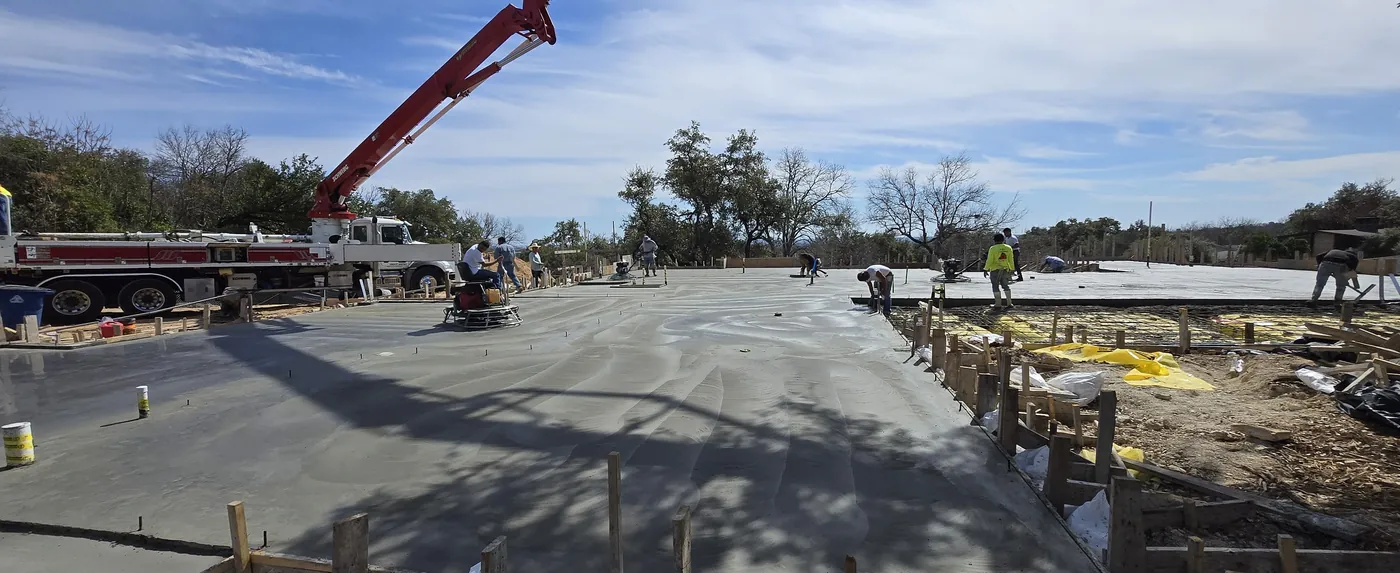
A concrete driveway in Austin counts against the lot's impervious cover limit, and on most single-family lots that limit is 45% of the lot for everything hard combined. The driveway shares that allowance with the house, the walks, the patio and the pool deck, so its size and route are usually settled on the site plan long before anyone talks about finishes.
This guide covers what the City counts as impervious cover, which part of a driveway it leaves out, how the limit changes with zoning and lot size, and where protected trees push the layout around.
What counts as impervious cover in Austin?
The City of Austin defines impervious cover as any human-made surface that does not absorb rainfall, according to the Development Services glossary. The same glossary lists walkways, impermeable driveways, rooftops, parking areas and some decks as part of the calculation.
The Land Development Code, Section 25-8-63, names driveways outright alongside roads, parking areas, buildings and concrete. A driveway is not a gray area in Austin: every square foot of slab on the private side of the property line is in the number.
The City's residential permit application carries one useful partial credit. An uncovered wood deck with gaps between the boards, built over a pervious surface, counts at 50% of its area rather than all of it.
Does the driveway approach count?
The approach usually does not count, because it sits in the public right-of-way rather than on the lot. The City's glossary describes the right-of-way as land the City owns or controls, typically the street, sidewalks, alleys and the grassy strip between the pavement and the property line, and it says impervious cover does not include paving in the public right-of-way.
Section 25-8-63 says the same thing for sidewalks, excluding sidewalks in a public right-of-way or public easement from the calculation. On a typical Austin frontage, that means the approach and the public sidewalk it crosses are permitted and inspected as right-of-way work, while the driveway behind the property line is the part that spends the lot's allowance.
The split matters on the plan. Impervious cover for the driveway is measured from the garage to the property line, not to the street, so a takeoff that runs all the way to the curb overstates what the lot is spending.
How much impervious cover does an Austin lot get?
The limit depends on zoning, and the City's interactive permit guide points to the site development table in LDC 25-2-492 for each district's numbers. The City's staff review for the HOME code changes lists the standard one-unit limits this way:
- SF-1: 40% impervious cover, 35% building cover
- SF-2 and SF-3: 45% impervious cover, 40% building cover
Building cover and impervious cover are separate tests. On an SF-3 lot the house footprint can use up to 40% of the lot, which leaves only the difference between the two limits for the driveway, walks and patio if the house is built out to its full building cover. That gap is why a large footprint and a long driveway on the same infill lot tend to collide.
The City's HOME page sets the same pair of numbers, 45% impervious cover and 40% building coverage, for duplex, two-unit and three-unit projects in every zoning district, and it notes that garages and carports count toward both.
What changes on small lots and flag lots?
Small lots carry a front yard test on top of the lot-wide limit. The City's review of the HOME Phase 2 changes limits front yard impervious cover to 50% of the front yard and does not allow a garage or carport between the house and the street, so a small-lot driveway has to fit the front yard as well as the whole lot.
Flag lots changed too. The same review notes that the flagpole strip, which is usually the driveway, used to fall outside both lot area and impervious cover, and that the HOME changes count it so a site stays within 45%. A long shared or private drive back to a rear lot is now part of the budget.
Does gravel or pavers get around the limit?
Gravel does not get a driveway around the limit. The City's permit application excludes gravel over a pervious surface only when it is used for landscaping or by pedestrians, and Austin Watershed Protection states on its drainage charge page that driveways count whether they are paved or unpaved.
The same department explains why the City counts so closely. Impervious cover increases the amount and speed of stormwater and the pollutants it carries, and Austin's drainage charge is calculated for each property from the amount and percent of its impervious cover, so a smaller driveway also means a smaller line on the utility bill.
How do protected trees affect where the driveway goes?
Trees often decide the route before impervious cover does. The City Arborist treats every tree 19 inches or larger in diameter as a Protected Tree that needs a permit for removal or impacts, and oaks, pecans and other listed species 24 inches and larger may be Heritage Trees that need a variance.
The regulated area is the critical root zone, a circle around the trunk with a radius in feet equal to the trunk diameter in inches, so a 20-inch tree carries a 20-foot radius. A new approach often runs straight through the root zone of a street tree, which is why the driveway line, the curb cut and the equipment path are worth settling with the arborist review rather than on pour day.
Who decides the driveway layout?
The site plan decides it: the designer or engineer sets the driveway's footprint inside the lot's impervious cover budget, and the City reviews it against the zoning numbers and the tree rules. What DB Concrete brings is the flatwork side of that plan, a measured takeoff of the driveway, walks and patio together, and the right-of-way side, since DB Concrete is a registered City of Austin Right-of-Way contractor that pours the approach and the private driveway as one scope.
For the details of how that single scope works, see concrete driveways and flatwork and curb, gutter and sidewalk work. If a driveway is on a plan that is tight on impervious cover, send DB Concrete the site plan early, while the layout can still move.
Published Nov 3, 2026